Skin studies · Collagen first
Copper Peptide Skin Research: Skin cells made more collagen
You’ll see what lab cells and small skin tests showed. You’ll also learn why the cream or serum mix can change your result.
Human skin cells made more collagen after GHK-Cu
Maquart’s team asked whether GHK-Cu changed collagen. In 1988, they removed cells from human skin and kept them alive for tests. Collagen rose across every amount tried. The paper writes the span as 10⁻¹² to 10⁻⁹ M, meaning trillionths to billionths of a chemist’s count in one liter. The rise peaked near the 10⁻⁹ M end. Cell count didn’t change [1]. The same cells made the added collagen; extra cells weren’t the cause [1].
More than collagen changed. A skin review said treated cells added other support material. One of those proteins helps line up collagen fibers. Small trials found firmer, denser skin and softer lines than placebo [3]. The review also found a change in how cells clear old support tissue [3]. You’re seeing signs of repair and upkeep, not proof that any bottle will rebuild your skin.
Copper peptide helped skin make support and clear worn tissue
Here’s what changed. Collagen and elastin both rose in treated skin cells. Other support material rose too. Small trials found denser skin, more firmness, and softer lines than placebo [3]. Lab work also found better defense from cell damage. The cells cleared worn support tissue in a different way [6]. You can see the reason for interest, but a serum may not make those changes in your skin.
Getting through skin is hard for GHK. The compound favors water, while your outer layer is oily. That layer blocks much of it [13]. Still, one human skin test found 97 millionths of a gram of copper across each square centimeter in deeper skin after 48 hours [5]. Some copper got in. The product mix largely sets the amount that passes.
Copper Peptide vs Retinol: One review favored GHK-Cu
The short answer is no. The studies don’t fairly rank finished products. A review found a collagen response in 70% of people using GHK-Cu. Retinoic acid had 40%, and vitamin C had 50% [3]. A 2025 wrinkle review repeated the same 70%, 40%, and 50% figures. It also warned that GHK moves poorly through the outer skin layer [13]. The product mix can decide how much reaches deeper skin.
The review counted how many people showed a collagen response. It didn’t test store products side by side. Retinoic acid, also called tretinoin, is the stronger prescription cousin of retinol. Retinol is the milder form found in many store creams [3][13]. More people responded to GHK-Cu in the studies reviewed. That doesn’t prove any GHK-Cu serum will beat any retinol product [3].
The serum mix decides how much copper gets below the outer skin layer
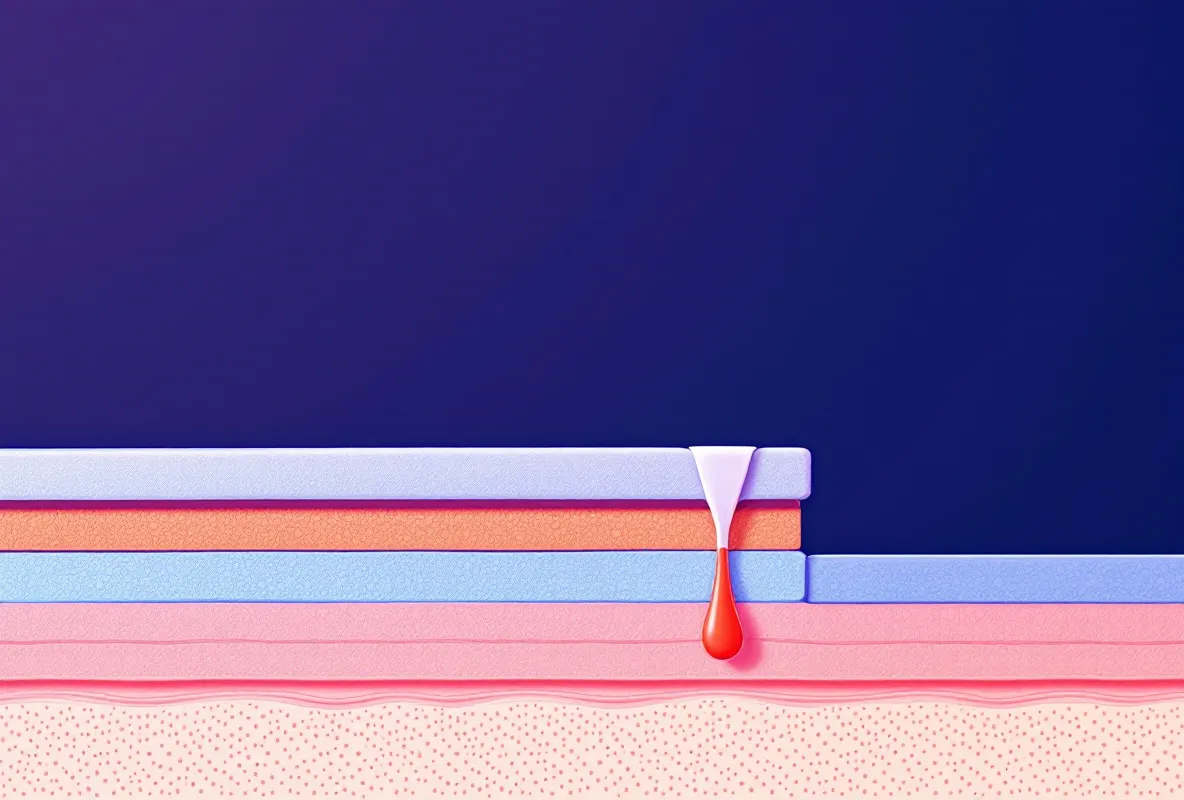
GHK doesn’t cross your outer skin well by itself [13]. A 2025 review compared ways to get more through. One method added a fat-like part so GHK could move through the oily layer. Others used tiny fat shells, an oil-and-water mix, or very small needles. With the needles, roughly 134 nanomoles got through, and a nanomole is one billionth of the amount chemists use to count tiny pieces. Almost none passed through untreated skin [13].
A useful mix must also keep GHK-Cu together. On the acid scale, the bond holds best near pH 5–6.5. Copper and peptide work best as a 1:1 pair. Blue-violet is normal when the bond is sound. If the color turns brown or green, your product may have broken down [6]. Below about pH 3.5, a much more acidic mix, vitamin C may snap the bond. Other strong acids can break it too [6]. The label amount alone won’t tell you how the product will act.
What the skin studies can answer
These answers stay with the skin tests. You’ll see where a finding came from and what the test still can’t tell you.
What can copper peptide do for your skin?
What can copper peptide do for your skin?
It may help your skin build and arrange its firm support. A 2015 review said treated cells added collagen and several other materials. Small tests also reported more density and firmness, plus less marked lines than placebo [3]. Collagen wasn’t the only change. Material around each skin cell changed too [3].
Did GHK-Cu increase collagen?
Did GHK-Cu increase collagen?
Yes, in cells removed from human skin and kept alive for testing. Collagen rose between 10⁻¹² and 10⁻⁹ M, meaning trillionths to billionths of a chemist’s count in one liter. Cell count didn’t move, so the same cells made the added collagen. Maquart reported it in 1988 [1]. Later work grew from this main finding [1]. You’re still not looking at a large trial in people.
How long did GHK-Cu take to firm skin?
How long did GHK-Cu take to firm skin?
No single start time has been proved. After weeks to a few months, small trials reported firmer skin and less deep wrinkles [3]. A 2025 review warned that GHK has trouble crossing the oily outer skin layer [13]. Two products may carry very different amounts into your skin. Those dates won’t tell you when your skin might change.
Is GHK-Cu better than retinol for collagen?
Is GHK-Cu better than retinol for collagen?
We don’t have a strong side-by-side product test. One review reported a collagen response in 70% of people using GHK-Cu. It found one in 40% using retinoic acid and 50% using vitamin C [3][13]. That makes GHK-Cu look useful in those studies. It doesn’t prove that one bottle is better for you [3].
What can break GHK-Cu apart?
What can break GHK-Cu apart?
Strong acid may loosen the copper. Below about pH 3.5 on the acid scale, vitamin C can snap the bond. Peeling acids found in skin products can tug the metal loose too [6]. GHK-Cu holds together best near pH 5–6.5, which is far less acidic [6]. If the bond breaks, you can’t count on the same action.